Sunday, 7 May 2017

Scottish Unionist have changed their colours from Red to Blue.

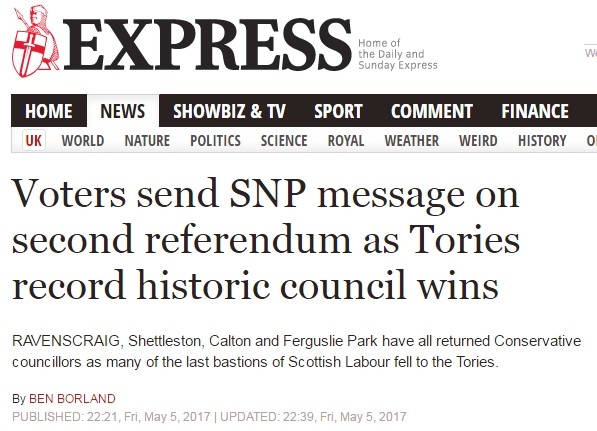
The  UK Unionist have been giving the impression that the Tories had  somehow won the local elections in Scotland
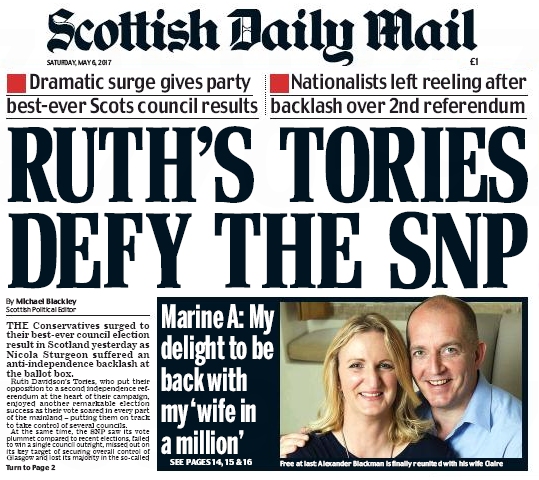
The Truth is that the SNP incensed its number of seats  with 431 elected compared to 425 in 2012. So this table which seems to have taken in By-election wins is misleading.

PartyCouncils[27]+/-Seats+/-
SNP0Decrease1431Decrease7
Conservative0Steady276Increase164
Labour0Decrease3262Decrease133
Independent3Steady172Decrease26
Liberal Democrat0Steady67Decrease3
Scottish Green0Steady19Increase5
No overall control29Increase4n/an/a

What really happened that the Tories made advances at the expense of another Unionist Party Labour,

The Nationalist-Unionist Dynamics continues what as changed is one of the players have changed their colours from Red to Blue.

Much as been made of the collapse of UKIP but the Liberal Democrats are still going into reverse.in Scotland and Wales
PartyCouncils[26]+/-Seats+/-
Labour7Decrease3472Decrease107
Independent3Increase1322Increase13
Plaid Cymru1Steady202Increase33
Conservative1Increase1184Increase80
Liberal Democrat0Steady62Decrease11
Llais Gwynedd0Steady6Decrease7
Green0Steady1Increase1
UKIP0Steady0Decrease2
No overall control10Increase1n/an/a

x
PartyCouncils[26]+/-Seats+/-
Labour7Decrease3472Decrease107
Independent3Increase1322Increase13
Plaid Cymru1Steady202Increase33
Conservative1Increase1184Increase80
Liberal Democrat0Steady62Decrease11
Llais Gwynedd0Steady6Decrease7
Green0Steady1Increase1
UKIP0Steady0Decrease2
No overall control10Increase1n/an/a
Incidentally Plaid were second in the UK for net gains after the Tories.

One aspect that is rarely mentioned is that unlike England and Wales . Scotland  uses the Single Transferable Vote . It would be interesting  to see what a Welsh Result would look like under this ,

It would certainly see the Unionist Parties running candidates in Plaid's Gwynedd stronghold but this might be offset with gains elsewhere and see the Party putting a real effort in areas like Merthyr, Blaneau Gwent and Torfaen,

We now turn to the UK General election clearly the Unionist  Media will beef up their Tories in Scotland and hail any SNP losses as scuppering a second referendum.

Wales will be ignored apart from a almost colonial  claim that the Tories will win big .

 They will not claim it as an English Annexation of Cymru , but you will only have to look at thier faces to see its what they feel and want to say,

Saturday, 6 May 2017

Small political earthquake in Wales nobody particularly harmed.


There was no Political Earthquake in Wales Yesterday;

The full picture has emerged from the local elections - 
Ten councils across Wales now have no overall control, while the Conservatives won control of Monmouthshire and Plaid Cymru retained control in Gwynedd.

Pembrokeshire is controlled by Independents.

The Prediction had  sthis forcast
Labour: -130 seats
Conservatives: +90 seats
Plaid Cymru: +20 seats
Liberal Democrats: No change
Independents/Others: +20 seats


On paper both the Tories  and Plaid made games but in fact these were patchy though  only Plaid exceeded  expectations.
PartyCouncils[24]+/-Seats+/-
Labour7Decrease3472Decrease107
Plaid Cymru1Steady202Increase33
Conservative1Increase1184Increase80
Liberal Democrat0Steady62Decrease11
Llais Gwynedd0Steady6Decrease7
Green0Steady1Increase1
UKIP0Steady0Decrease2
Independent3Increase1322Increase13
No overall control10Increase1n/an/a
Although Labour lost 107 seats control of councils in Bridgend, Torfaen, Blaenau Gwent and the Vale of Glamorgan. They cleverly predicted losses and therefore managed to get the BBC  to claim the big story was  Labour's performance has not been as bad as many predicted.

The party retained control of Rhondda Cynon Taf, Caerphilly, Neath Port Talbot and Torfaen as well as the key city councils of Newport, Swansea and Cardiff.


Three of these councils have sen scandal and defections and yet they clung to even increased their majority in some.

Prehaps this reflects the lack of popular local news outlets.


In Wales the party has won Monmouthshire but failed to stage an outright revolution. If it had won Cardiff, Newport and Swansea the scene would be set for a repainting of the electoral map in June.

This failed to happen, and perhaps  the idea that Wales was going to be seen as hardly differing from England is not yet true


There was no epic surge in support for Leanne Wood’s party but it has made progress at a time when the Conservatives have devoured Ukip support and are in pursuit of a landslide.

It has increased its majority in its Gwynedd heartland and won the largest number of seats in Carmarthenshire and Anglesea

The party will take particular encouragement from the result in Neath Port Talbot, where it gained seven seats on 2012, and in Rhondda Cynon Taf where there was a nine seat increase. Plaid cherishes the dream of challenging Labour in its South Wales heartlands and it scored a major breakthrough last year when Ms Wood won the Rhondda’s Assembly seat.


But no expected breakthrough in Cardiff a loss of seats in Caerphilly and the RCT result ay have seen the Rhonda area turn a majority green but the Cynotn Valley  is solidly red and i south former Plaid stronghold like Llantwir Ffadre and Pontyclun saw the Tories win seats .

RCT Election Map 2017


Plaid may have concentrated on tthe Rhondda but has lost major ground in parts of the council


For the Liberal Democrats this election should have been a golden opportunity for the party to show it is on the road to recovery. after heavy losses last time they saw this continue. with a net loss of 11
But o Cardiff, where there has been talk of the Lib Dems taking the Westminster seat of Cardiff Central back from Labour, its share of councillors fell. There were also setbacks in Swansea, Wrexham and Bridgend.

Ukip hvw no seats in Wales whilst the Grens have a sole seat Powis.

To what extent Mrs May calling an General Election affected the Result   is anyone's guess. but may be  those who considered switching  from labour were alarmed at stories of Tory Landslide in Wales.


Friday, 5 May 2017

Should we have stricter control on electoral spending?


As we await the results pf the local elections it is well worth considering the democratic deficit that still allows some candidates to spend huge amounts of money compared with their rivals


According to the  Guardian
 The Conservatives’ candidate to become West Midlands mayor has defended spending up to £1m on the campaign, dwarfing his opponents’ spending power.
Andy Street, the former John Lewis boss who quit to run for the role, said targeting voters before spending rules began could be justified because the role was vital to 2.5 million people in Birmingham and the surrounding area.
The comments come ahead of a tightly fought race and a string of mayoral contests to be held on Thursday. Many council elections are also happening that day.

There is a strict spending limit of about £130,000 during the final five weeks leading up to the 4 May election but there is no cap on spending before that, and most of Street’s material was distributed during January, February and March.
Siôn Simon, Street’s Labour opponent, said the rules on spending on mayoral elections should be tightened. 
“You can’t blame Andy for sticking to the rules but it does beg the question whether the rules are right. I think the rules are wrong. In general elections, the regulated period starts much earlier. No rules at all, a complete free for all, until six weeks before polling day – I don’t think that’s the right way to go about it.”


Labour’s campaign spending is thought to be between £100,000 and £200,000. It has focused on social media campaigning and phone banks, where volunteers call up voters to ask for their support. The Lib Dem candidate has spent about £50,000.
Although  the rules are stricter for other elections it still is the case that Parties can spend money on electoral campaigns as candidates nurse a seat .
Often it is disguised as a Newspaper but still manage to give prominence to a candidate.
Election spending Rules are there for a reason but all Parties and some Independents run close to the wind  when it comes to how much they spend in the period between elections.
But the case in the West Midlands shows we need tighter control.Perhaps we need the equivalent of an Ombudsman  who can exert some control over the abuse  of spending in elections.


Thursday, 4 May 2017

Labour are still "Confused" over devolving Policing to Wales.

Do Labour have any idea what their devolution polices regarding Wales are.
In a a BBC Radio  interview Dian  Abbott on Tuesday when she said 
we don't think it's right at this time to devolve policing, but this is something there's constant discussion about inside the Labour Party".
She later said: "We will make our position clear on this in the coming weeks."
 But Labour's  general election campaign chairman in Wales. Wayne David said Welsh party colleagues have 


"more of an ear to the ground than perhaps Diane".
Mr David said Labour's 2015 manifesto was very clear 
"that we favoured, at that time, an all-Wales plan drawn up by Welsh ministers".
"That will certainly be in the manifesto, but is likely to be embellished upon and the final details are being worked on as we speak.
"The Labour Party is firmly committed to extending devolution."
"It is still being discussed," he added
"Because we are in Wales we have got a little bit more of an ear to the ground than perhaps Diane.
"But nevertheless I can tell you that the Labour Party is firmly committed to strong policing, to neighbourhood policing and devolved policing as well."
However he denied Ms Abbott had got her facts wrong.
You can understand her confusion
We have been here before
Speaking in a House of Commons debate,in March last year  the then Shadiw  Home Secretary Andy Burnham said devolving policing powers was an "interesting proposal".
"But it's the view of the Labour Party in Wales. It's not yet the view of the party at a UK level but we will be giving it serious consideration," he added.
Labour's manifesto for last year's general election had  included a pledge to give the Welsh government policing powers.
ForewordWe will strengthen devolution once again, guaranteeing fair funding for Wales, as well as powers over policing, energy, transport and elections.
Page 13We will help make communities safer, by protecting and strengthening neighbourhood policing and will devolve to the Welsh Government the powers to shape the priorities and the governance structures for policing in Wales.
Page 52We will devolve powers over policing so that Welsh Ministers can devise an all-Wales policing plan to ensure it reflects Welsh priorities.
Page 62The Welsh Government has long demonstrated that locally made and locally accountable decision making is both more legitimate and effective. So we will give more powers to the Welsh Government, legislating early in the next Parliament to devolve to Wales powers outlined in the cross party Silk Commission, including on policing and elections, energy and transport.

As the must missed Syniadau pointed out   

This is not an absolutely unequivocal commitment to "devolve policing", but better interpreted as a commitment to devolve some powers over policing ... specifically so that Welsh ministers "can devise an all-Wales policing plan" and set up appropriate "governance structures for policing in Wales".

In a similar confused stae a month later to Ms Abbot a month later Mr Burnham insisted that the UK Labour party also supported the transfer of powers over policing from Westminster to the National Assembly.

When it came to Westminster voting Labour failed  to  back devolution of Police powers.o be included in the  in the last Wales Bill.

Policing powers are only a sample  of Labour's continuing confused state over Welsh powers.

Its almost as if they secretly are looking forward  to Scotland leaving the Union so they can with the Tories absorb Wales into England , perhaps ending Devolution altogether.

After all they seem content to sit in opposition to a cruel and callous permanent 
Tory Government rather than copying Scotland,


-

Wednesday, 3 May 2017

Are the Tories finding Brexit not as popular as they thought?

Maybe the Tories are finding Brexit is not going as well among the electorate as the Tories thought it was/

Yesterday thier candidate for the Beddau ward on R.C.T  Sam Trusk posted this on Facebook page 


Sam Trask for Beddau ward23 hrs
With all the media hype surrounding the General Election next month, don't forget this Thursday is your chance to vote for who you want to represent you in your local council chamber, to make a real difference to local matters. This isn't about Brexit, it's about Beddau.

Which is all rather strange because  I had an election leaflet from him with this prominent feature.


It id true that this should be about local matters but the Tories are hoping that Mrs May suicidal Brexit tactics will carry them into gains on Thursday's Local Government .

But maybe as they knock on the doors they may be shocked to find that there are still people who are not following her Xenophobic mantra and believe  the Leave vote was a mistake.

It's probably wishful thinking on my part and the Tories who have 28 candidates in Rhondda Cynon Taf may make a breakthrough .

I wish there had been a Plaid  candidate but as there is a straight Labour-Tory fight in Beddau I will be voting for the Labour Candidate Richard Yeo. 

I don't want to see any Tories riding into my council on  Brexit coattails even if he seems to distancing himself.

Tuesday, 2 May 2017

Which Party in Wales will be smiling on Friday?

Maybe it will be the Party of Wales?
Over at Elections in Wales Dr Roger  Scully has been musing over  Thursday local authority elections which have been possibly scuppered by the Tories calling a General Election.  Professor Scully
"The national mood at present is defined by Conservative dominance. Though many still view them as “the nasty party” (a term coined fifteen years ago by the current Prime Minister), the reality is that the Tories currently face no serious or credible opposition outside of Scotland and Nicola Sturgeon’s SNP. Jeremy Corbyn has not persuaded most people that he offers effective leadership, while the Liberal Democrats are only at the start of a long road back after their crushing defeat in the 2015 general election.
The strong position of the Conservatives, and the weakness of the other parties, was reflected in the recent Welsh Political Barometer poll. This pointed to significant Tory gains, and substantial Labour losses, in the general election. Something similar is also likely this Thursday. Colin Rallings and Michael Thrasher from the University of Plymouth have estimated council seat gains and losses based on the Barometer poll’s question on local election voting intentions. This, they suggest, points to the following overall changes":
Labour: -130 seatsConservatives: +90 seatsPlaid Cymru: +20 seatsLiberal Democrats: No changeIndependents/Others: +20 seats
There should be a note of caution here, other factors can come in to play here and people do not always vote locally as they do  in the UK elections .
Plaid for instance could make the 20 seat gains in Rhondda Cynon Taf and Caerphilly alone.
They will also be eyeing Carmarthen, Neath Port Talbot and something in my water suggests some surprising gains in Wrexham
Whilst the Liberal Democrats will be expected to regain some of their Old Cardiff wards though  they and Plaid may regret not having some form of pact and cancel themselves out.
They will be looking to revive in Swansea , though may be blocked by a Tory  upswing
The Tories will make gains and I suspect some Token candidates  may find themselves elected.
Professor Scully  points out that...
"Roughly eight percent of all the seats up for election in Wales have only one candidate. This is very similar to the proportion that were uncontested in 2012 – something which stood in stark contrast to Scotland, where there were no uncontested seats. The full list of uncontested seats that have thus already been won by each party is as follows":

Plaid Cymru: 28 (+6 on 2012)
Independents: 26 (-7)
Labour: 18 (+1)
Conservatives: 5 (+3)
Liberal Democrats: 1 (-1)
He continues //

"Why are there uncontested seats? The parties often have difficulty finding people who want to be candidates – a problem likely to be greater in more sparsely-populated parts of the country. To many people being a councillor looks like a thankless task, with little reward, that they are not willing to commit to".
 Indeed some councillors once they get over being  defeated seem content to retire from the fray and not stand again .

Being a councillor can be a thankless  task at times taking the role of a Social worker and facing the wrath of the electorate  for every decision.

Gone are the Days when your local Labour Councillor held God like powers in his (it was largely men) ward.

Labour hegemony  may still exist but they have temporarily lost power in many of their strongholds and will do again.

Whether this will happen on Thursday  we will see.

I will however leave the last word to Professor  Scully who  sums up the position  better than I can


"More obvious is that we just have too many elected councillors in Wales. Wales has a population of a little more than three million compared to Scotland’s of just over five and a quarter million. Yet Wales has more elected councillors: 1,271 here to Scotland’s 1,219. That gives us roughly one elected council representative for every 2,360 of us, compared to around one for every 4,343 people in Scotland. Scotland also has a strong advantage over Wales in that it uses the proportional STV system for its local elections. That means that every (multi-member) ward is competitive: everyone has something to fight for. In Wales, under a non-proportional system, we have lots of safe wards where parties are reluctant to fight if they are certain they will lose. There is a strong, and in my view compelling, argument for moving to STV for local elections in Wales".

Monday, 1 May 2017

Could the Tories intend to 'grab back' Welsh NHS?


Is Leanne Wood right t to ck aim Control of the Welsh NHS could be "grabbed back" by Westminster after the general election 

Health has been devolved in Wales since 1999 and is the responsibility of the Welsh Labour Government.

But maybe Ms Wood remembers David Cameron  "Boarder of Death" controversy when in a a speech to the "Welsh" Conservative Conference in 2014/.

He said

“Patients are waiting weeks and weeks for vital heart scans. One in seven people in Wales is on an NHS waiting list.
“A Cancer Drugs Fund in England – but not here.
“I tell you - when Offa’s Dyke becomes the line between life and death, we are witnessing a national scandal.
“There are people who have seen the ones they love waiting far, far too long for treatment, sometimes dying and these grieving families are in pain.
“They want answers. Investigations. But Labour just do not get it.
“Faced with grief, they demand evidence. Faced with evidence, they demand silence.
“It’s the same old socialist mantra: the system knows best.
“Well, I tell you, after this utter shambles Labour should never dare call themselves the party of the NHS again.”
Some then thought that indicated that the Tories would  use the stare of the Welsh  to reclaim  it .despite the wanton state of the health service in England.

Clearly iif Wales ceases to exit as a political identity if the Tories win the most Welsh seats in June then they will claim to have a mandate from Welsh voters.


The Plaid Cymru leader fears the Tories could "grab back" powers if they increase their UK mandate on June 8. 

She pointed to the list of reserved powers in the recently passed Wales Bill, claiming it suggested there were some powers which could be "dragged back" to Westminster.
"The Tories have attacked the Welsh NHS quite viciously," Ms Wood said.
"If they increase their mandate then I wouldn't put it past them to try to take powers back from Wales over the NHS, and then, of course, we risk our NHS being privatised."

 A spokesman for the Welsh Conservatives said: 

"Responsibility for the Welsh NHS has been a matter for the Welsh Government for a generation, so these claims are a cynical attempt by Plaid to exploit uncertainty over the devolved settlement and should be treated with the contempt they deserve."In fact, the Welsh Conservatives in government have strengthened the devolved settlement in recent years, and the recent Wales Bill offers greater clarity and accountability than ever before in the devolved era.

"But the Welsh Conservative will not decide on this. It will Mrs May who will claim that she has not only been given a Mandate to conduct Brexit as she likes, but to start to privatise the NHS .

How much would it be easier for her to do this if she seized the Welsh NHS.

She might even turn her eyes to Scotland if there was a no vote in a second referendum,  Claiming that this would strengthen the Union.

The "Strong and Stable mantra is a cover for give me claim that I have a mandate to run things as I want, and has she has shown in her actions over Brexit , she will be willing to silence any  opposition in Parliament  no matter what.

A Tory victory on June the 8th will see the Tories ,via gerrymandering of seats and manipulating voter registration, become the permanent party of power

The only way to free ourselves of this is to free ourselves of the Union,